
Your Location:Home > Products > Pharmaceutical intermediates >84057-95-4
Product Details
|
Biological Functions |
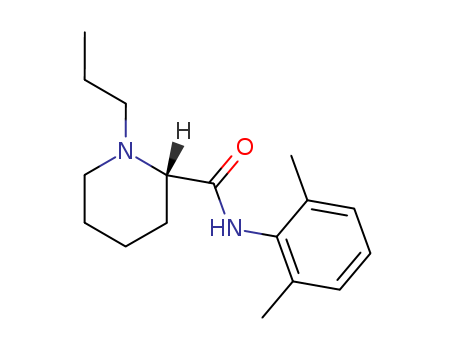
Ropivacaine (Naropin) is a recently developed longacting amide-linked local anesthetic. Its duration of action is similar to that of bupivacaine, but it is slightly less potent and requires higher concentrations to achieve the same degree of block. Its primary advantage over bupivacaine is its lesser degree of cardiotoxicity. |
|
Mechanism of action |
Ropivacaine is a member of the amino amide class of local anesthetics and is supplied as the pure S-(- )-enantiomer. Local anesthetics block the generation and the conduction of nerve impulses, presumably by increasing the threshold for electrical excitation in the nerve, by slowing the propagation of the nerve impulse, and by reducing the rate of rise of the action potential. In general, the progression of anesthesia is related to the diameter, myelination and conduction velocity of affected nerve fibers. Clinically, the order of loss of nerve function is as follows: (1) pain, (2) temperature, (3) touch, (4) proprioception, and (5) skeletal muscle tone. |
|
Pharmacology |
This is a single (S–) enantiomer, similar in structure to bupivacaine. S ubstitution of a propyl for the butyl side chain of bupivacaine reduces lipid solubility; this leads to reduced potential for toxicity and also greater separation between sensory and motor blockade. Efficacy is similar, but motor block is reduced compared with equianalgesic doses of racemic bupivacaine. |
|
Side effects |
Reactions to ropivacaine are characteristic of those associated with other amide-type local anesthetics. A major cause of adverse reactions to this group of drugs may be associated with excessive plasma levels, which may be due to overdosage, unintentional intravascular injection or slow metabolic degradation.Check with your doctor or nurse immediately if any of the following side effects occur:More commonBlurred visionchest pain or discomfortconfusiondizziness, faintness, or lightheadedness when getting up suddenly from a lying or sitting positionlightheadedness, dizziness, or faintingslow or irregular heartbeatsweatingunusual tiredness or weaknessLess commonBurning, crawling, itching, numbness, prickling, "pins and needles", or tingling feelingschillsdecrease in frequency or amount of urinedifficulty in passing urine (dribbling)feverpainful urinationRareAbsence of or decrease in body movementagitationanxietyhttps://www.mayoclinic.org/drugs-supplements/ropivacaine-injection-route/side-effects/drg-20065875https://www.accessdata.fda.gov/ |
|
Metabolism |
The metabolism of ropivacaine in human is mediated by hepatic CYP1A2 isozymes and, to a minor extent, by CYP3A4. The major metabolite is 3-hydroxyropivacaine, and the minor metabolite is (S)-2′,6′-pipecoloxylidide (a N-dealkylated product).Ropivacaine is extensively metabolized in the liver, predominantly by aromatic hydroxylation mediated by cytochrome P4501A to 3-hydroxyropivacaine. After a single IV dose approximately 37% of the total dose is excreted in the urine as both free and conjugated 3-hydroxy ropivacaine. Low concentrations of 3-hydroxy ropivacaine have been found in the plasma. Urinary excretion of the 4-hydroxy ropivacaine, and both the 3-hydroxy N-de-alkylated (3-OH-PPX) and 4-hydroxy N-dealkylated (4-OH-PPX) metabolites account for less than 3% of the dose. An additional metabolite, 2- hydroxy-methyl-ropivacaine, has been identified but not quantified in the urine. The N-de-alkylated metabolite of ropivacaine (PPX) and 3-OH-ropivacaine are the major metabolites excreted in the urine during epidural infusion. Total PPX concentration in the plasma was about half as that of total ropivacaine; however, mean unbound concentrations of PPX were about 7 to 9 times higher than that of unbound ropivacaine following continuous epidural infusion up to 72 hours. Unbound PPX, 3- hydroxy and 4-hydroxy ropivacaine, have a pharmacological activity in animal models less than that of ropivacaine. There is no evidence of in vivo racemization in urine of ropivacaine.https://www.accessdata.fda.gov |
|
Definition |
ChEBI: A piperidinecarboxamide-based amide-type local anaesthetic (amide caine) in which (S)-N-propylpipecolic acid and 2,6-dimethylaniline are combined to form the amide bond. |
|
Brand name |
Narapin [as hydrochloride] (Astra). |
|
General Description |
The recognized increase in cardiotoxicity of one bupivacaineisomer led to the stereospecific production of ropivacaine asthe single “S” (-) enantiomer. Ropivacaine is the propylanalog of mepivacaine (methyl) and bupivacaine (butyl). ThepKa of the tertiary nitrogen is 8.1, and it displays the same degreeof protein binding as bupivacaine ( 94%). Althoughropivacaine has similar properties as bupivacaine, it displaysless cardiotoxicity. The shortened alkyl chain gives it approximatelyone third of the lipid solubility of bupivacaine. |
InChI:InChI=1/C17H26N2O.CH4O3S/c1-4-11-19-12-6-5-10-15(19)17(20)18-16-13(2)8-7-9-14(16)3;1-5(2,3)4/h7-9,15H,4-6,10-12H2,1-3H3,(H,18,20);1H3,(H,2,3,4)
Capillary electrophoresis (CE) methods b...
A novel and enantioselective synthesis o...
The preparation method comprises the fol...
The invention discloses a preparation me...
The modulation of pharmacologically rele...
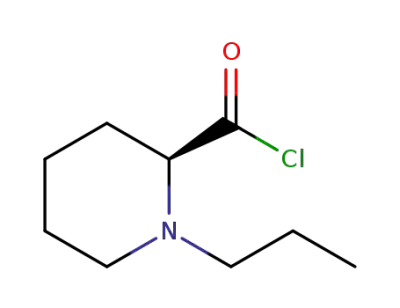
(S)-1-n-propylpiperidine-2-carbonyl chloride


2,6-dimethylaniline

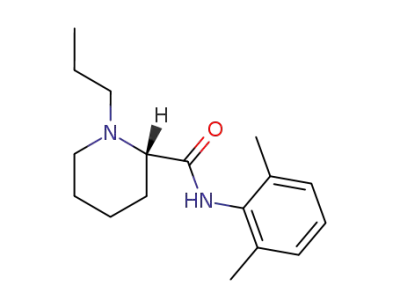
ropivacaine
| Conditions | Yield |
|---|---|
|
With
potassium hydroxide;
In
N,N-dimethyl-formamide;
at 20 - 45 ℃;
for 3h;
Reagent/catalyst;
|
92.4% |
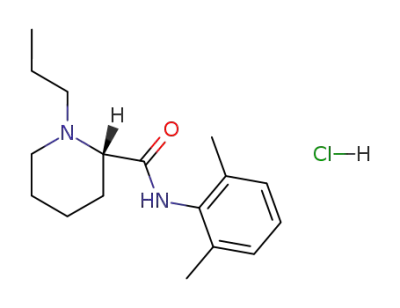
ropivacaine hydrochloride
ropivacaine
| Conditions | Yield |
|---|---|
|
With
sodium hydroxide;
In
water;
pH=10;
|
91% |
|
With
ammonia;
In
methanol; water;
at 25 - 30 ℃;
for 1h;
pH=9.0 - 9.5;
|

1-propyl-N-(2,6-dimethylphenyl)piperidine-2-carboxamide

propyl bromide
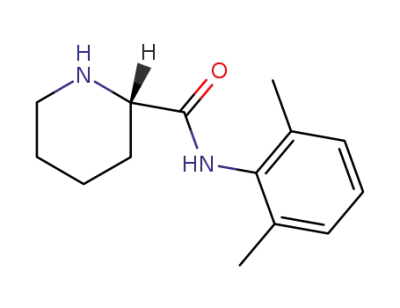
(S)-2',6'-pipecoloxylidide
ropivacaine hydrochloride
ropivacaine hydrochloride
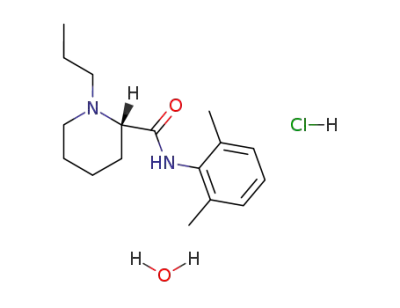
ropivacaine hydrochloride monohydrate
1-propyl-N-(2,6-dimethylphenyl)piperidine-2-carboxamide
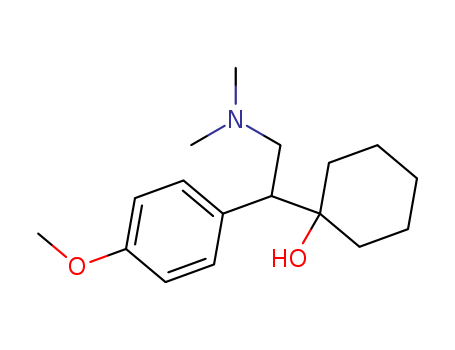
CAS:93413-69-5
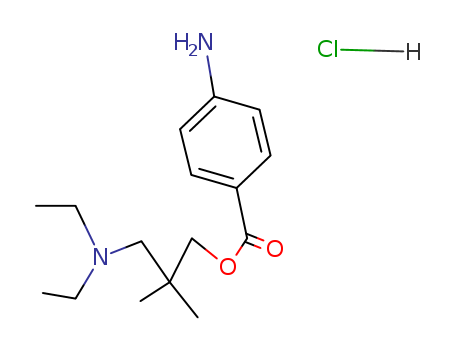
CAS:553-63-9
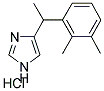
CAS:106807-72-1
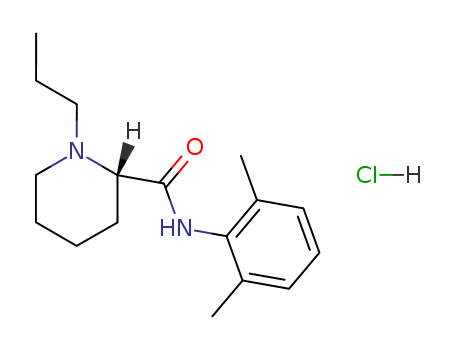
CAS:98717-15-8
